
Riddling
Left, right, upside down

Currently in a holding pattern with a few things I’m not quite ready to talk about, so I’m writing about champagne today. I’m going to paywall it partway down; paid subscriptions help support our champagne appreciation (haha, but no, really) but also please know that I give paid subs to anyone who asks. All tip jar funds go towards food and cold drinks for people here in Libreville, Gabon, specifically people who work outside where we live.
In a future post I might be able to write about being assaulted in a grocery store parking lot last week by a child (he was maybe 11-12) who backed off when he saw the candy I was able to dig out of a grocery bag, but not today. A lot of violence comes from need, and there is a lot of need here.
Until then, this is my version of chamber music on the deck of the Titanic, and maybe it’s also an entry-level technical lecture for the many people who keep a cold bottle of bubbly at the ready, just in case something happens suddenly that is worthy of a celebration, but who haven’t yet had occasion to inquire deeply into how the wine itself comes about. Below the paywall, there are more pictures and a video from inside the church where Dom Perignon is buried.
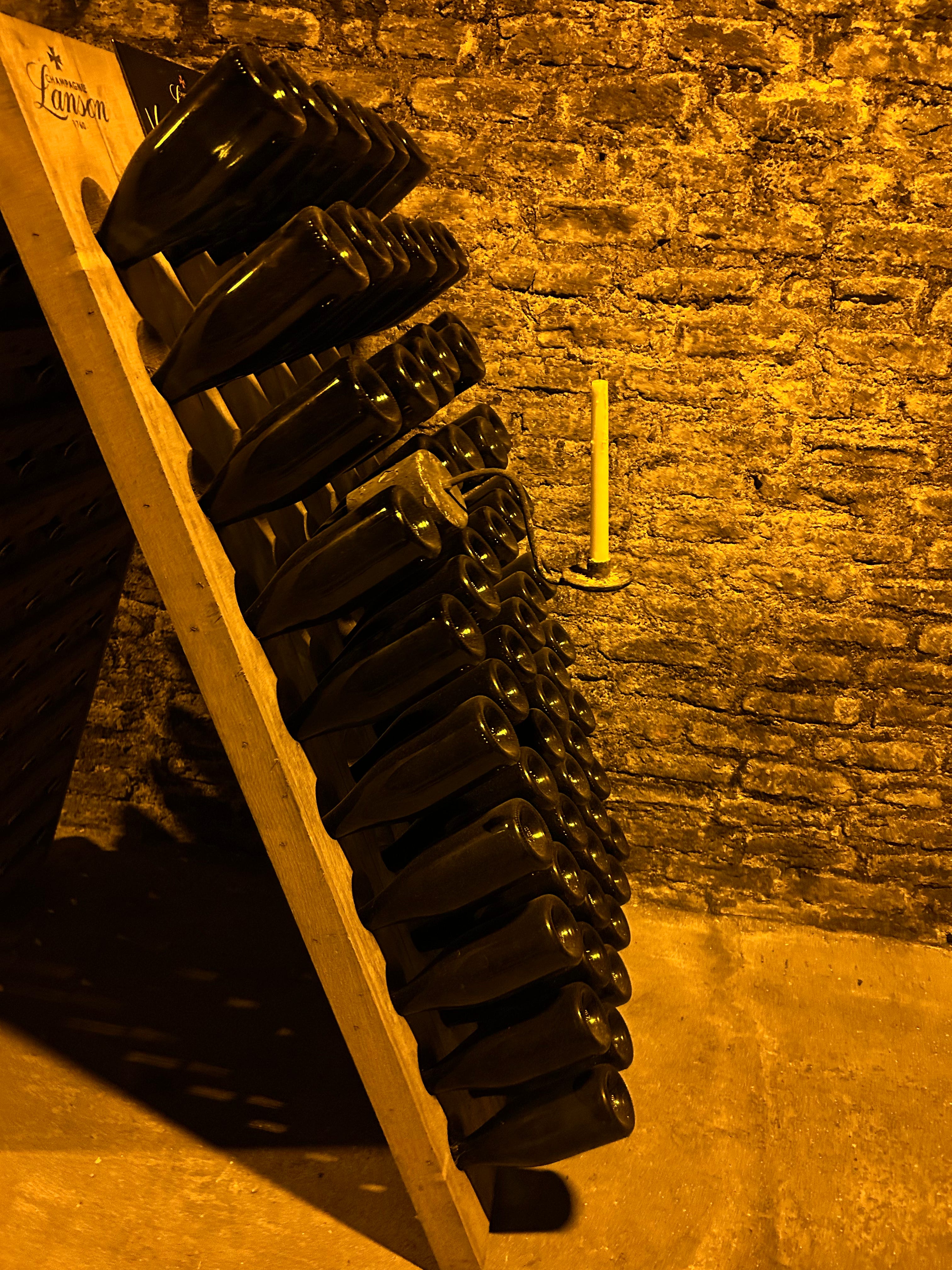
(Riddling racks at Champagne Lanson, in Reims. The candle holder fitted over the end of a bottle was made precisely for the purpose of illuminating the kilometers of chalk caves storing thousands of bottles, before electricity)
Since our visits to the Champagne region, I am less inclined to drink any other kind of alcohol; if I can’t have champagne, I’d mostly rather just go without: Aut optimum, aut nihil. I can’t stomach the mark-up here in Gabon (a bottle of Taittinger Brut Reserve, usually less than 40€ duty-free, can be 52,000 CFA/ 80€, or more), so we drink only what we can pack in our suitcases or carry from duty-free at Charles de Gaulle, and we save it for Fridays. When it’s gone it’s gone, until the next time we pass through Paris.
I have not always appreciated champagne; I liked it and could taste differences between various bottles, but I could only say that, yes I wanted to keep sipping it, or no, thank you; I couldn’t say why, because I didn’t understand. Nate and I wanted to understand, so last spring, we set out to learn:
“We slowly worked our champagne count skyward, starting with the glass we were served on Air France on the way up from Libreville (the flight attendant showed us the bottle and assured us that “it’s really good! It’s not what they get in business class, but it’s good”). By the end of our trip, after three full weeks in France, the number was 53. These were tastes, of course, not bottles! And real champagne pours are small; a glass opens the meal. (Our favorite restaurants were the ones where they poured you a glass as soon as you sat down). We counted each small taste at every cellar tour, ordering separately when we could and sharing sips, ordering separately at restaurants and comparing notes. We drank champagne almost exclusively; one time I ordered a glass of regular wine and was astonished at how large, at a standard 5 ounces, the pour was.")
-from Prunes and Speck, Two Americans in Champagne, April 24, 2025
Champagne, the place, is special in that it focuses on one beautiful thing and does it well. The village of Épernay, in the heart of the Champagne region, is a factory town; its product is champagne. Its infrastructure supports this industry first, wine before tourism, unlike Reims, the larger city to the north, with its extensive offering of restaurants and France’s third largest Christmas market.
In Épernay there are apartment buildings for the workers, bed and breakfasts for the tourists, and cafés, bistros, and tasting rooms for everyone. I found corks among the primroses in the garden of our little hotel, itself an old champagne house, and it seems like everyone drinks champagne at every meal; it’s cheaper by 3-4€ a glass there than in Paris and at one café right in the middle of town, the coupes are on the table with the silverware, just waiting to be filled.
The villages around Épernay are mostly clusters of champagne houses surrounded by hectare after hectare of vineyards; these are the places that have baguette vending machines because, well, France. Like escargot in convenience stores, the need for a baguette qualifies as urgent.
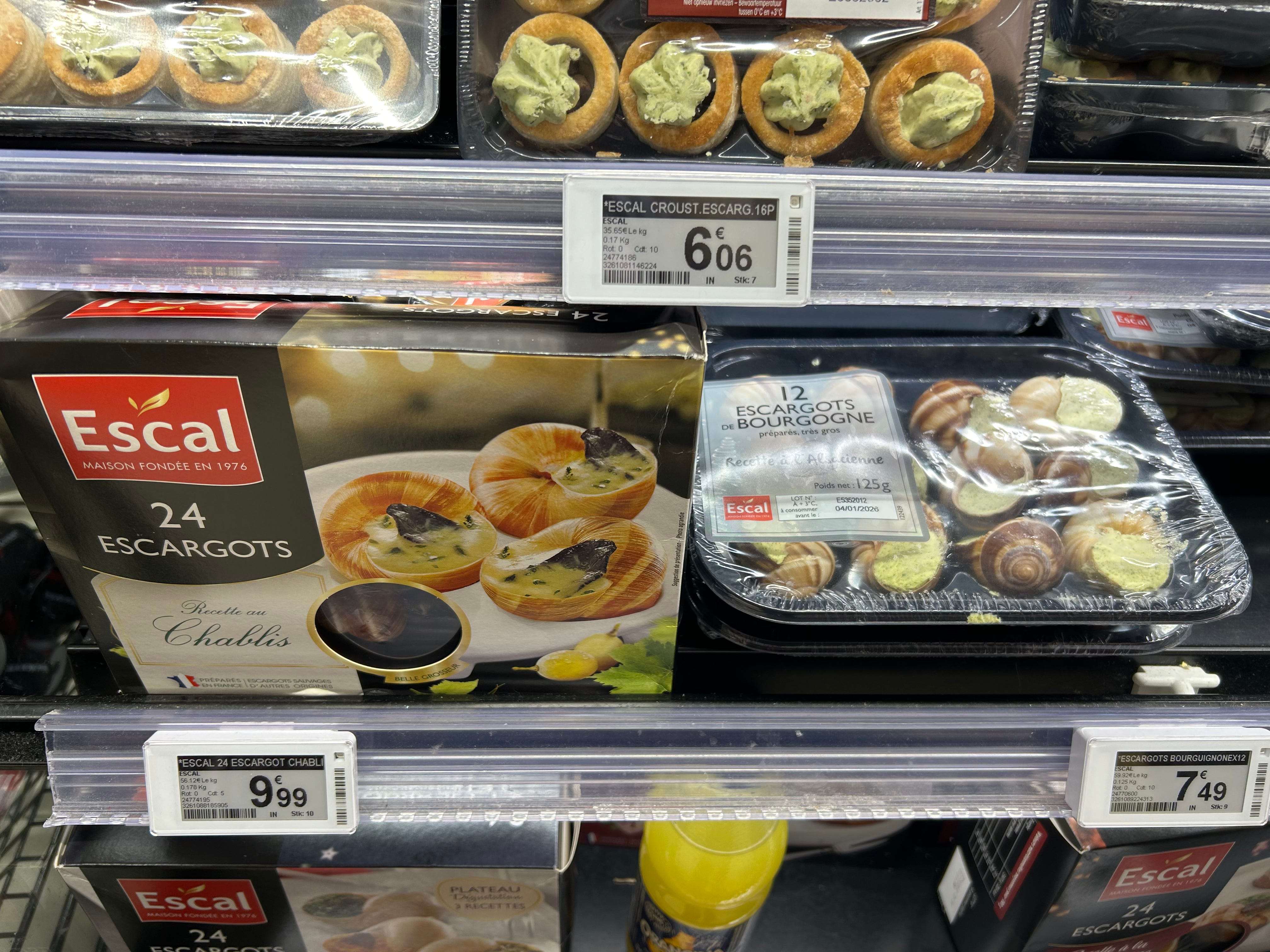
(I wasn’t kidding; ready-to-cook escargots in a little Monoprix Express…)
Walk along the street outside Moët & Chandon any time of day or night and you’ll hear the clinkclinkclink of bottles lightly bumping up against each other as they move around on conveyor belts. Deep underground, an old school riddler (“remueur”) walks through the chalk tunnels, wrists in constant motion, shifting bottles incrementally: left, right, down. Lees rise and fall, stir and settle. A good riddler can turn tens of thousands of bottles in a day.
“Riddling” is what is done to bottles of champagne to settle the lees (dead yeast, leftover grape particles) during the second fermentation, the one that produces the bubbles, before disgorgement and corking. The bottles start out on their sides and are turned slightly in each direction before being tilted down just a bit, gradually moving towards vertical, so that over time, the sediment gathers in the neck. It can take months if done by hand, which it still is sometimes, weeks if done by machine.
Of course I love the word “riddling” itself and all its metaphorical implications, that clarity comes through disturbance, that being shaken slightly, bothered, redirected, turned upside-down so that all that is dead, all that is no longer growing, is gathered together and expelled and what’s left behind is clear, and precious. A little bit of wine is spilled during disgorgement, when the lees are removed and the cork goes in. No change comes without loss.
