
Terrifying the Oppressor
Your faith, in yourself and others, will make you whole

There is a bright blue Woodland kingfisher spreading its wings on a roof across the compound, maybe in a mating dance, maybe just because it’s feeling exactly how beautiful it is. The first time I saw one, the first week we were here in Libreville, I nearly drove off the road. Fortunately, it was a dirt road, more of a goat path (yes, with actual goats), behind the embassy. The goats, shaggy, even more wild-eyed than goats usually look, sometimes wander out along the main road, but I have yet to see any harm come to them.
“The role of the artist is to terrify the oppressor” has become something of a rallying cry recently, and it’s calling me out of my retreat. That, and the kingfisher, led me to put down the book I’m reading and pick up my laptop.
The book, Japanese by Spring, by Ishmael Reed, is a hilarious send-up of the self-interested gatekeeping so much of academia is plagued by, full of the stock characters of the professoriate (“President Stool,” “Chappie Puttbutt,” “Marsha Marx,” “April Jokujoku”). It is helping me remember, as someone whose career has always been on the fringes of academia, that I am not crazy, that it’s true that the drama is so high on campus because the stakes are so low.
A colleague unsubscribed from this newsletter last time I published, presumably because of these lines, referring to how so often, academic satire focuses on English departments:
“Right now I’m reading various campus novels, the only genre that is allowed to break the “revenge writing” rule (why is it always English departments? Why are English professors so often just ungodly assholes?”)
As a former English* professor, I think I’m allowed to say things like this. I would know! There are definitely assholes in other departments as well, but I haven’t had to sit through history or government or economics department meetings where supposedly grown-ass adults throw temper tantrums about not being elected chair, people repeatedly refer to themselves as “full professor,” like they’d ever let us forget, and where a mediator the college brought in to “fix” (lol) the toxic and dysfunctional environment compared the English department to a family of alcoholics.
“The role of the artist is to terrify the oppressor.”
The revenge-writing rule is generally that it’s not a good idea. Score-settling is for the insecure and weak-minded and rarely makes for interesting reading. Academia’s stuffiness, though, begs to be lampooned, which is why there is such a roaring appetite for stories from the inside. The best comedy is that in which the comedian pokes the most fun at themselves.
I, for two decades a perennial adjunct like the narrator of Japanese by Spring, was never quite sure who I had to appease to make sure I had a job the next term. The sands were always shifting, the rules always open to interpretation. When I finally got my hands on actual written policy (not an easy thing to do in the days before a widely accessible database, when the department secretary decided who had access to what, and when) and pointed out to the department chair the many ways the policy about staffing the extra first-year writing courses was not being followed, word got around that “Bess is a very angry person.”
In fact, I had not expressed anger at all, having been trained, as women are, not to do that, for fear, of course, of being labelled “angry.” I had merely asked a question about why the spouse of an incoming tenure-track professor was given courses ahead of me, when I’d been teaching there for years, with excellent evaluations.
There were two answers: the one I was given and the one that was true. The one I was given was that “well, we give priority to faculty spouses.” When I pointed out that I was also a faculty spouse (my then-husband’s job as an athletics coach was a faculty position), I was told that “well it means English faculty.”
But of course, that’s not what the policy said and of course it wasn’t true, except it was.
I wasn’t teaching there because I was a faculty spouse; I was teaching there because I was good. The incoming tenure-track professor’s deal had apparently been sweetened by an offer of employment for their spouse. My then-husband was offered no such deal; I got my job on my own. That meant I wasn’t quite as disposable, that I wouldn’t behave like other faculty spouses may have in the past, just “pitching in,” grateful to have something to do to fill the time in between serving tea in the afternoon and cocktails before dinner.
Do you see now why there’s a general rule against revenge writing? It can come across as whiny and bitter. If it’s funny at all, it’s darkly funny, with too much rage around the edges (I wasn’t angry then, despite being labeled as such, just naive, still wanting to believe that academia is a meritocracy, but I got angry and stayed angry for a long time, not that it did any good. Anger is designed to organize us for action; we’re not supposed to just carry it. The moment I understood that for myself, I became free to live the rest of my life on my own terms).
Revenge writing is often coming from a place that is still a wound, not yet a scar. As I wrote in that piece, wounds are not reliable narrators of anything except their own concerns. The pain is telling you that you’re hurt, that you’re not safe, that you need to stop what you’re doing and give the wound the attention it needs to heal. If you don’t, the wound will worsen and fester and you will get sick and die. It’s pretty much that simple.
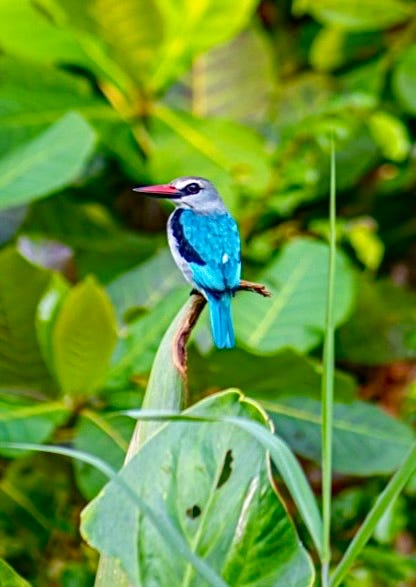
(a Woodland Kingfisher here in Libreville, Gabon; photo by Nicholas Busselman)
“The role of the artist is to terrify the oppressor.”
I’m one of those people who believes that there can be art in everything, in the simplest things, in the quietest, often unnoticed moments, that an artist is someone who says they are an artist. I don’t care if your art is your clean house, your messy garden, your half-knit sweater, the secret scribbles in your journal, three lines of a song, or the way you stop and watch the light change as the sun moves across the sky; you’re an artist, and the art you make matters.
And artists, simply by doing what we do, defy those who would say that we can’t live freely, love who we love, or speak truth to power.
Oppressors hate those they can’t control; narcissists hate healed, healthy people, because they can’t be manipulated. The last thing the oppressors want is for us to be okay, so we very much need to do everything we can to be okay.
There are more of us, more artists than oppressors. Remember that, on the especially hard days. There are more of us. Stand up and make your art, whatever form it takes, every single day that you can, so others can lie down when they need to, so they can stand up when you can’t.
If your faith in yourself waivers, the way mine often does, your faith in others will get you through. Just remember that you, your art, your very existence, is the reason we get up and keep going, too.
*English Departments, in the United States, usually have three areas of focus: Composition and Rhetoric, Cultural Studies, and Creative Writing. Where I teach, only the latter two were formally recognized, until very recently. I, primarily, but not exclusively, teach first-year writing and was in the English department when the events described here happened, but was later “moved” (can you guess why???) to a newly-created “Writing Program,” focusing on Composition and Rhetoric. It was its own thing and later became the “Writing Department.” So I was an English professor, but now I’m a Writing professor, more specifically a “Distinguished Senior Lecturer,” which is apparently a rank equal to full professor. Except that it’s really not. Academia can be very silly.
You can listen to me read this post here:
Reading your experience as an adjunct and the "angry woman" perception feels familiar to my experience in my current office. Part of my struggle has also been in accepting that the same leaders who sit with me in women-in-STEM seminars will still perpetrate unfairness to other women. Female identity comes after narcissistic control and intellectual insecurity for some.
Your writing helps me feel less alone/crazy for my feelings and experiences.
Hi Bess, I love “The role of the artist is to terrify the oppressor.” and yes many/most of us are artists. Having been only on the fringe of academia as an occasional Adjunct whose livelihood did not depend on it, I still resonate with your characterization. I think I might enjoy Japanese by Spring. Hope I can find it as an Audio book from the library. I have too many other books I am reading or need/want to read related to church and Companion activities.
I always enjoy your posts, especially when I can listen to your voice. Peace (which we have little of at this moment!) Betty