
Origin Stories: Why I Write
What would I tell that little girl in Alaska? What did she already know?

I love Jameela Jamil’s recent Substack post about being called an “angry old cat lady spinster whore”; in it, she describes herself:
“I’m most of the things we tell girls never to be if they wish to be loved. I am loudly critical of misogyny. I am chaotic. I am sloppy. I am undomesticated to the point of feral at times. I am confident. I am opinionated. I have leadership qualities. I am vulgar. I am independent. I travel a lot for my work. I can be embarrassing. I am successful. I am strange (in an unpredictable neurodivergent way- not like a kooky whimsical spontaneous manic pixie dream fuck way). I have a lot of friends, many of whom are men. I am opinionated. I am goofy. I am seen as aggressive (which is what we call straight forward, passionate women.)”
The post is in response to the internet’s surprise at the news that she has a long-term boyfriend, because, as Jamil puts it, a lot of angry men were convinced that she would (and should) die alone and women expressed surprise, too, she thinks because “girls and women are terrorized away from anything that feels rough around the edges, strong, autonomous and deeply human.” The post is about holding men, and ourselves, to the highest standards. I could quote it endlessly, but I hope you’ll just read it:

I fell asleep the night I read this post trying to think of ways I would describe myself, but it’s hard (which is why I admire her ability to do it) to separate out all the information we receive about who we are from our parents, our peers, friends, partners, children, if we have them, work colleagues, and so on, to name things about ourselves that don’t come from an outside assessment, a perspective that is not a reflection, but an idea that comes from a deep knowing of who, in fact, we are.
When I was three years old in Fort Yukon, Alaska, I held up my clenched fists and told a group of children sitting in a circle with me that “I’m only 3, but I’m still tough!” We’d been told to go around the circle and tell how old we were. This was in a Head Start class, a new program in Fort Yukon then, early childhood education for low-income communities. Most of the other kids had already turned 4. It was unwise to display any kind of vulnerability in Fort Yukon back then (you might think I am joking, but I assure you that anyone who grew up in Fort Yukon knows that I am absolutely not).
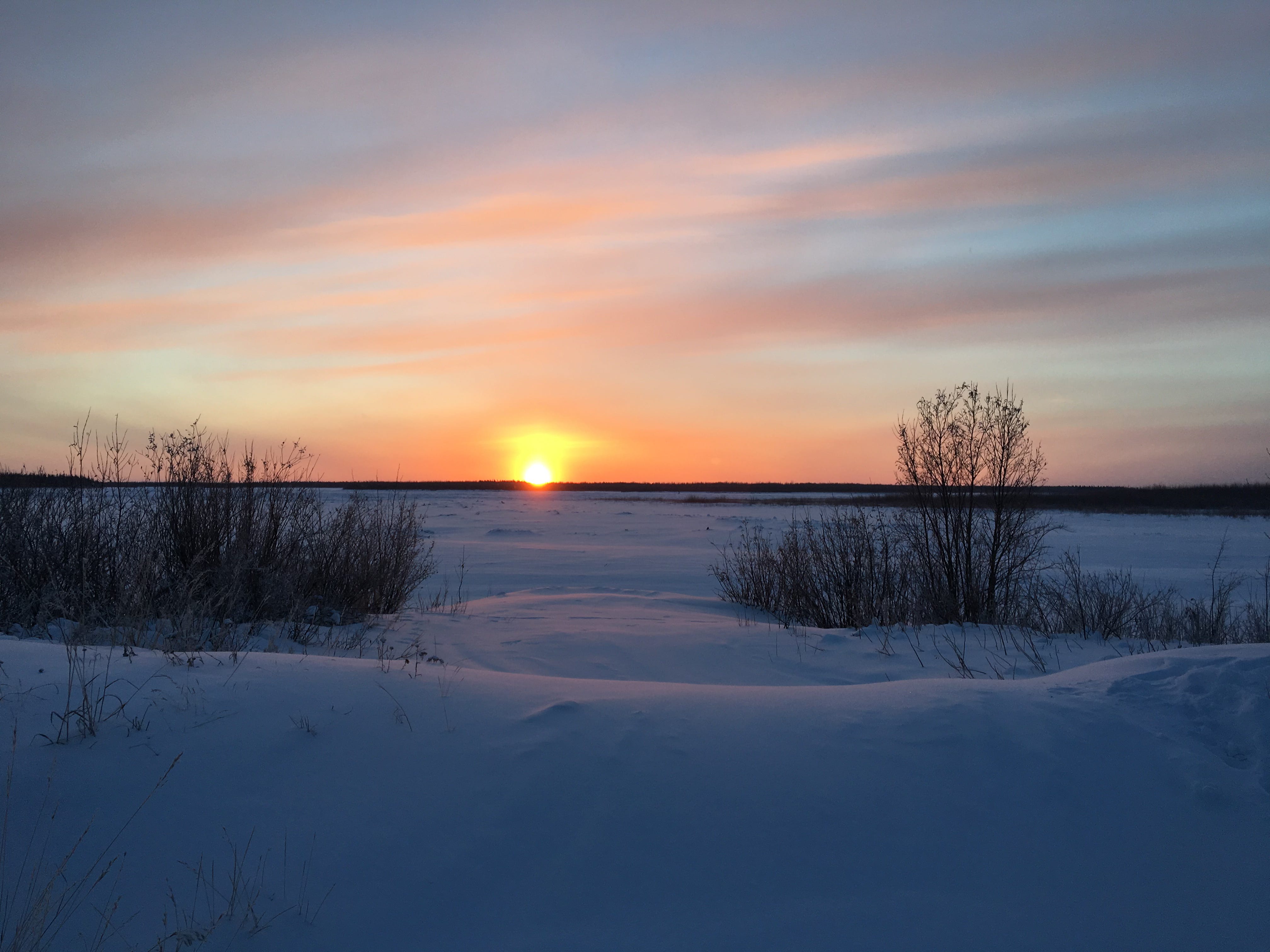
When I was in Kindergarten, I walked to and from school by myself every day. It wasn’t far, I know now, but it seemed so then (you can stand at the end of the driveway of the mission house in Fort Yukon and turn your head; you’ll see the school. But when I was being chased home with rocks being thrown at me, it seemed like a hundred miles).
On one of those walks to school (they left me alone on my way to school), I remember taking my right hand out of my mitten and just looking at it, fascinated, turning it over, back to front, studying its shape, feeling the cold winter air on my slightly damp, sweaty skin. From the way I remember the sun slanting high at that time of morning, it must have been late March or early April, the snow still deep but the days bright, the light stretching long toward the midsummer solstice, the midnight sun.
That morning walk was always quiet, a transition from home to a bright, loud, busy, sometimes violent classroom, where I never knew what was waiting for me. Other than playing in the yard by myself, those walks are the first memories I have of being alone in the world. I had to brace myself, but I could, on that walk.
It was, I know now, the beginning of a lifetime of wanting to walk everywhere, anywhere I have to go, if I can, because it helps me feel like I’m in control of my own destiny, like I can breathe and prepare for what’s next, stop and look around if I get lost, like there’s time to think and understand and know my own mind for a moment, at least a little bit.
I would tell that little girl that it’s okay to prefer your own quiet company over that of a group, that it’s okay if you don’t automatically know what to do, where to go, or how to behave; you can take the time to figure it out. And that just because everyone else seems to be having a good time, it’s okay to not want to be there, to want to run off screaming into the woods.
I would also tell her that she is in fact very tough, that she will survive a lot, and that she will find friends who will always love her. (One of those friends, from Denali Elementary School in Fairbanks, says that in first grade, I was “a little scary” because I was “from Fort Yukon,” which is precisely the impression that I, being from Fort Yukon, would have endeavored to convey).
I would remind that little girl that her happiest childhood moments were when she was deep in a book, either tucked inside a cupboard in the Fort Yukon mission house, under a blanket on the top bunk in the rental on 9th Avenue in Fairbanks, or laughing to herself while reading from her latest haul from the library in the creaky orange recliner, swiveled toward the fireplace to create a private nook in the living room on Pedro Street. (My mother heard me laughing one of those times and said that it made her happy, too).
I would tell her that it’s okay to rest before you’re tired. I would tell her that you never have to “earn” food through exercise. I would tell her not to try so hard to fit in.
What did she already know? I think she knew that she was a little crazy, but just in a not quite in control of herself way. She laughed so hard that sometimes she burst into tears, the excitement too much to handle. (Years later, her students would make her laugh and she would gasp for breath, speechless for minutes, to the point where the students stopped laughing and looked concerned).
I think she knew that she was, or could be, book-smart; I know she wanted to be. She wanted to understand things and know how they worked; she wanted to be able to read any book there was. She fought with Northanger Abbey for three or four years, dutifully checking it out from the library and struggling with the opening pages again and again before she could finally follow the plot. She would later teach that novel in a course on gothic literature.
Reading felt like walking: she could go at her own pace, stop and look around when she got lost or confused, go back over the same paths again and again, the vistas familiar and comforting. Her favorite books are in pieces now, held together with tape and rubber bands.
I think she knew her own mind, but she was afraid of some things: bears, the river (there’s only one, the mighty mighty Yukon), her dad getting hurt or lost, or dying (her dad’s rules for living included the Apollonian dictum “Know Thyself” and Scotland’s motto: “Nemo Me Impune Lacessit,” which is FAFO in its original Latin; she wanted to grow up to be just like him).
She knew where and when she felt safest: when everyone was home and in bed. She counted them and included herself: “one, two, three, four…” as she drifted off; she would do the same count decades later, when her two daughters and their father were asleep. But by then, she was lying awake for hours each night: “one, two, three, four…” The fear had taken over, in great part because she had children now, and when you have children, you are vulnerable in ways that can feel unmanageable, especially when you’ve understood from an early age that being vulnerable is dangerous.
I know what I would have wanted to know back then; I know some of the things I already knew, but I don’t know myself the way I wish I did. I am very lucky to have on good authority who I am to the people I love, but who I am to myself remains elusive.
And that’s one of the main reasons I write: I have yet to find the words.
I tell my students at the beginning of each term about the tremendous irony of my academic career: that I absolutely loathed writing essays when I was in college. I promise that I will try to give them what I didn’t have: a map, of sorts, for navigating the abyss. Mostly I just remind them that they are not alone, that they never have to be alone, and that words beget words beget words. These are, of course, the promises and reminders I give to myself.
I write because I want to understand, because I want to know things. I write because it’s hard, and it feels worth it at the end of a day when that’s all I’ve done. I write because I want to feel like I’m not a stranger to myself. I write because want to know who I was before all the hard things happened, if that’s even possible. I write to try to repair the hurt I caused because I didn’t know enough about myself soon enough to do better.
I write so I don’t constantly feel like running off screaming into the woods, so I can calm down and breathe, so I’ll not be afraid of laughing so hard I’ll cry, so I’ll not be afraid anymore, of anything, at all.
You can listen to me read this post here:
I'm speechless. I had to take a moment to step away at little Bess being tormented at school - my mama bear ferocity wanted to grab that little girl and also wanted to yell at the adults around her that SHOULD NOT have allowed that to happen once let alone daily. (Deep breaths).
What I want you to hear, is that we see your heart and you are all heart. Love you.