
Doing Good 3/7
"If money can solve it, it's not a problem" and other lies I told myself just to get by.

(Scroll to the end to listen to me read this post).
I’m making today’s post free, even though it’s more personal history than travelogue, because it’s about being broke and how shitty that feels, so I want anyone who knows that feeling to have access (and again, if you’d like a paid subscription to No Half-Measures, please just message me, no questions asked).
Around 2016 or so, I think, I saw something in the snow and my gut knew it was money before my brain did. My gut even knew it was a twenty-dollar bill. I drove over it and waited a few seconds before pulling forward just enough, hopping out and quickly scooping up what was in fact twenty dollars lying in the parking lot of the athletic center at the college where I teach, in Maine.
About eight or ten years earlier, I had been walking out of this same building and just ahead of me, a student knelt down and picked something up, yelling “Twenty dollars! Beer’s on me tonight!” I had to force back tears, because all I could think about was how much relief that twenty dollars would have brought us, how unfair that it was going to be wasted on beer when we needed laundry detergent, and gas. I needed a new bra.
We, my husband at the time and I, weren’t poor. He has a full-time job coaching at that same college; I taught part-time and took care of our two children, who were toddlers then. We owned our own home, a small one, in a quiet neighborhood. But saying that money was “tight” doesn’t really describe how precarious it felt at times, “it” being everything, including our marriage, which was governed by a powerful silence.
I had heard, in the late 1990’s, when I was in graduate school, the saying “if money can solve it, it’s not a problem.” It was a self-proclaimed “money guru” on either Oprah or a morning news show, or both, advising all the Gen-Xers (who had managed to both graduate from college into the worst job market in decades and miss the dot com bubble before it burst) that we were basically screwed if we weren’t throwing money into a 401k with both hands. What I took from that message was to quit whining, you’re not dying, suck it up, basically the same message we had gotten all our lives.
So that’s what I told myself a few short years later, when I was a young mother also trying to have something like a career. “If money can solve it, it’s not a problem.” The girls were healthy and so were we, we had a roof over our heads, no tragedies had befallen our families. We were lucky.
I took care of the finances, did the grocery shopping, paid the bills, so I was keenly aware of how little, if anything, was left at the end of every month. We moved about in the dark after sunset to keep the electric bill down, wore fleece jackets inside, and closed off part of the (already small) house so we didn’t have to heat it. I once asked my husband to stick apples from the dining hall into his pockets whenever he ate lunch with his athletes so I could feed them to the girls, but he just gave me a funny look and said, “I can’t do that.”
I can point to my student loans as a reason for our financial struggles, but there was credit card debt, too, from things like heating oil and winter tires, and groceries, when our money didn’t quite stretch all the way to the end of the month. We would almost always go into our overdraft, and therefore start off the next month even further behind. (We were lucky to have the overdraft option, another benefit of home ownership). Our debt accumulated; it was easy to fall behind and all but impossible to catch up, especially when our cars, used and old, needed fixing. I would get behind the wheel, close my eyes, and whisper “Please start. Please, please start.”
My work was unsteady; as an adjunct, I didn’t know if I’d have a job from semester to semester, or how many classes I would be hired to teach, so we couldn’t rely on my income. I would overhear colleagues in the faculty lounge asking each other where they stayed when they went skiing at various resorts, or about their favorite restaurants in Paris and Madrid. I couldn’t afford a cell phone. We were all essentially doing the same job, but mine wasn’t a “real” one; I was teaching first-year writing, the work traditionally given to the faculty wives, the trailing spouses married to the Shakespearean, the Romanticist, the Victorian scholar.
My job instability is ultimately what saved us, though, ironically, because we could only budget based on my husband’s salary; anything I earned went straight into whatever we owed. People were generous with hand-me-downs for our girls. Family members gave or bought me clothes I could teach in. A friend of mine inherited some money and purchased a laptop computer for me so I could write (as an adjunct, I was only allocated a desktop computer, for my office on campus, which did me no good, as I was mostly a stay-at-home mother).
When I wasn’t hired to teach as many classes as I’d hoped for, I focused my energy on gardening, freezing and canning as much of the food as I could. A farmer friend gave me the carcasses of the chickens she’d butchered the meat off of and I made soup with them all winter. We slowly paid things off, but it felt like clawing, so many years of just hanging on.
It was lonely, that progress, and stressful. I still can’t go into the grocery store without my heart rate jumping just a little bit.
When we made the last payment on my student loans, I wrote the amount we owed on our credit cards on a whiteboard on the refrigerator, and watched the number get smaller and smaller for a few more years until one day I rubbed it all the way out with my finger and let my hand fall to my side.
I didn’t feel free, or triumphant. There was nothing I wanted to run out and buy. I didn’t want to go to a restaurant to celebrate. I just wanted not to worry about money anymore, but in some ways I wanted to never stop worrying, for fear of taking my eye off the ball and finding ourselves back in debt somehow.
What was so strange was that I knew that on the outside, we didn’t seem much different than the colleagues or people we interacted with on a daily basis. No one would have guessed, I don’t think, that things felt so bleak. (And I imagine that it might have been the same, or similar, for some of them, too.) But for far too long we were just one catastrophic car problem or health issue away from not being able to make a mortgage payment. For years, if my husband had lost his job, we had no way of paying the next month’s bills; we would have been bankrupt almost immediately. And we hadn’t gotten to that place by living beyond our means, by taking vacations we couldn’t afford, or driving expensive cars. We were educated professionals, but had chosen a path that offered more career satisfaction, supposedly, than money, in an environment where we contributed to the prestige of the institution but didn’t have access to its resources in a way that let us live with any financial security.
The dissonance was weird to live with, but I’m grateful for it, now, for the perspective it has given me. We had supportive families and friends; if we struggled as much as we did, how is anyone who has less than that supposed to make it work?
I am white, able-bodied, middle-class, and from people who had access to education. My parents took out loans to send me to college, and paid all of it back themselves. I took out a student loan to pay for my first year of graduate school, before I was able to get funding by teaching my own classes. My debt was low in the grand scheme of things, only about $30K, but the other piece of that privilege is that I was supported by all the social structures in place in the U.S. in my pursuit of higher education.
Students of color often have to borrow more money than their white counterparts, and at a higher interest rate. People with disabilities, if they want the financial support available to them, have to navigate funding sources with often vastly differing rules of eligibility. Rather than encouraging a wide variety of people to go to college and graduate school, the system all but guarantees that academia will continue to be dominated by those with unearned privilege.
I washed dishes when I was in college. I rolled burritos at night when I was in graduate school. I was often tired, and deeply resentful of people who had more, other students in my undergraduate and graduate programs who didn’t have to work.
And I hated the student ahead of me on the sidewalk who picked up the twenty dollars and spent it on beer. I couldn’t get past how unfair it all seemed. Because it’s not.
The lump in my throat all those years ago when I realized I’d missed out on that money by about five seconds wasn’t just about laundry detergent, or gas. It was about something like personal dignity, something I secretly knew I was short on, because the shame of being so chronically broke dominated my experience of being in the world back then. I wanted so badly to be able to say to that student, “Um, excuse me. I know you found that and are going to keep it and buy beer for your friends. But it’s not yours. Someone dropped it. It wasn’t me, but if it was, it would really be bad if I lost it.”
But I didn’t. I couldn’t. I just walked away, wishing hard that I had been out the door first. Because I would have kept that money, too.
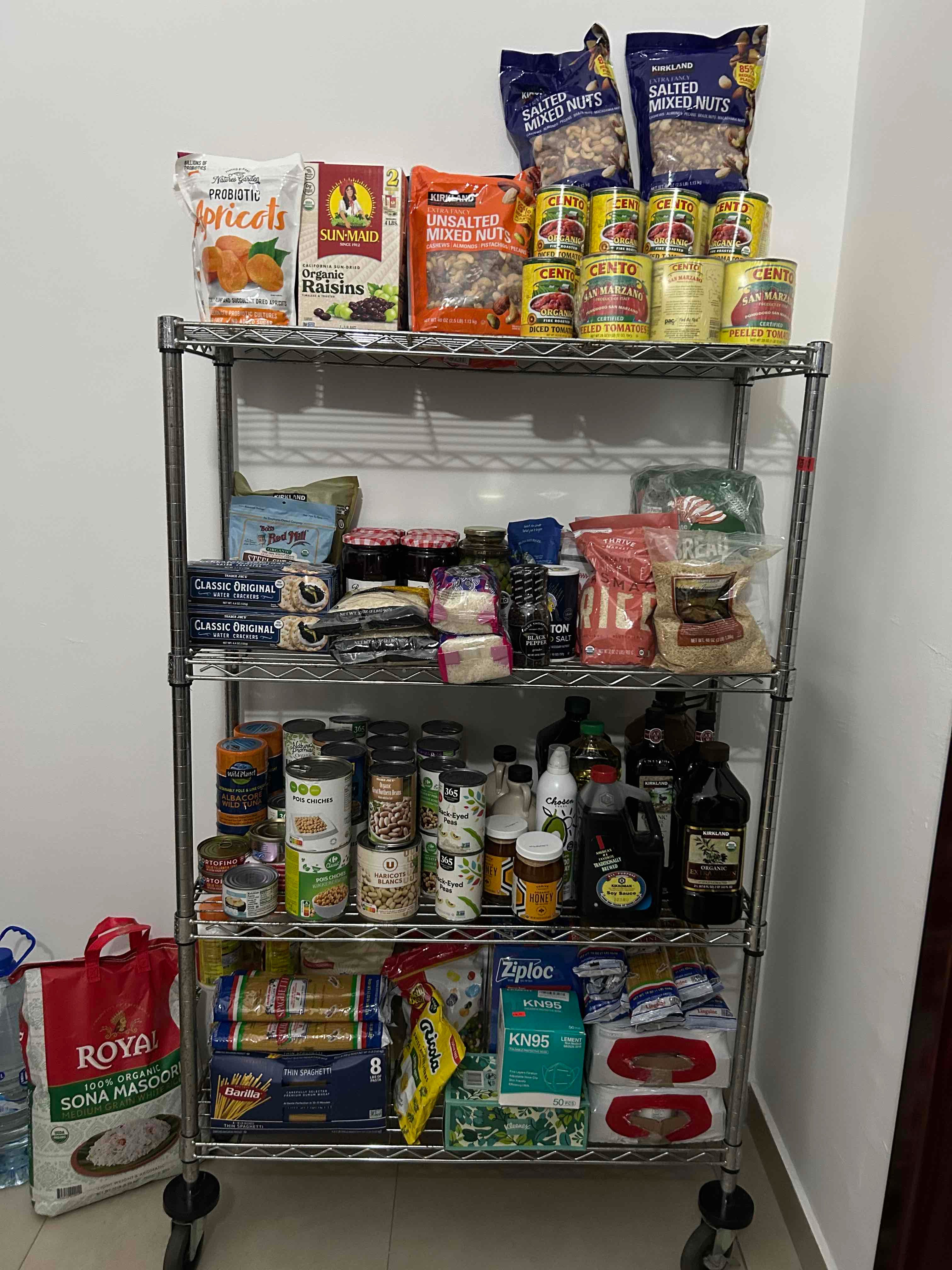
(Our Consumables shipment, which arrived last week. If you’ve ever had to put groceries on a credit card, or know what it’s like to just be able buy food for a couple days at a time, you know how what a relief it is to have a full pantry.)
Ten years later, seeing that twenty-dollar bill in the snow triggered something in me that I didn’t like, something I thought I’d left behind. I was still too close to the edge of feeling scared all the time, scared of the “what ifs” (what if the car doesn’t start, what if we run out of heating oil, what if the roof starts leaking again or the septic pump quits or or or…)
After I picked it up, I drove straight to campus safety and explained to a confused security officer where I’d found it. I doubt it ever got back to whomever it belonged to, and chances are it was someone’s beer money in the first place. Taking it to security was kind of dumb. I could have given it to the local homeless shelter, or padded the tip the next time we went to a restaurant, because we had started being able to do that. We had the money we needed to buy laundry detergent, gas, apples, bras.
When the college finally starting putting tampons and pads in the bathrooms, ostensibly for students, I noted that I wasn’t seized with the urge to take any. I would have cleaned them all out just a few years prior.
Over time, I had picked up more courses, and the college started to pay me something closer to my value as a classroom teacher. My parents distributed most of what would ultimately be their “estate” (my unearned privilege of generational wealth), which let us pay off our mortgage. I was thrilled, as one would be, of course, at not having a mortgage payment.
I exhaled each month, seeing the checking account balance rise instead of dropping back down to less than $100, or worse, less than $0.
But finally having enough money to pay our bills comfortably did not save our marriage.
The moral of today’s story: Money could not solve the problems we had, which were, not atypically, about our inability to communicate with each other more than anything else. But I thought it could; I thought if we had enough money, everything would be okay. So I thought our problems were not serious ones. I thought “serious” problems were things like disability, terminal illness, death, things you can’t buy your way out of.
I used this idea to flog myself for my failure to manage our household finances properly. I was embarrassed about having less than our peers. I was ashamed of having credit card debt, and afraid of my parents’ disapproval.
We couldn’t talk about any of it.
It was emotionally exhausting, and it affected how I felt about everything. There’s no way that it didn’t impact my children, though I tried to make sure they always had everything they needed, and more, trying to shield them as best I could. That I could was also a privilege.
I loved my time with them as they were growing up, but unlike a lot of mothers, I don’t wish it back. I don’t wish them back to their childhoods, except in my fantasies where I’m healed, healthier, whole, so I can be that for them. They survived and are thriving, as far as I can tell, with as much as I am allowed to know.
I did my best. I could have done better. I wish I had.
I know better now about money and problems and the difference between the two. I especially know better than to listen to or take advice from self-help “gurus” who think they know better than everyone else. I’m no different than a lot of people who think obsession with money is gross, and yet we all need it to do whatever our version of “survive” is.
I’ve never been wealthy and I never will be, but I have been broke and I have been okay.
And when you’ve been broke, being okay is pretty wonderful. Being okay is sometimes everything.
You can listen here:
Last week to get the New Year’s discount:
Money is a big trigger for me too. Lots of reasons, but l hear you.